
Steering the Tail Exercise, Part 1
July 10, 2014
Written by: Keith Hosman
Written by: Keith Hosman
|
This is part 1 of a two-part article series. Click here to jump to part 2.
What you'll get: A horse that turns without drifting; the ability to calm or slow a jiggy horse, the beginnings of a solid foundation "Riding instructions for you and your horse: This simple exercise teaches you how to control your horse's direction, speed, and more." 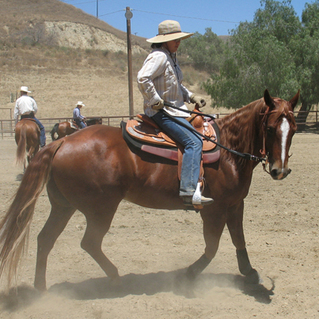
Practice"Steer the Tail" because: Your horse's "power," its drive comes from the rear. Your ability to control this energy is critical to controlling your horse today - and building a solid foundation for tomorrow. This exercise is mandatory for those looking to put a good solid foundation on any horse.
Note: A follow-up article (to this one) called "Steering Your Horse" is also available. It explains "What to do if..." your horse develops a slingshot action with its head; what to do and what not to do; common mistakes and a lot more. Consider it "Part II" to this article. Find that other article here on this site. The training exercise in this article can be done at a walk or even at a stand still. (Though, as with most training, it's much easier if you have movement.) When you feel comfortable, do it at a trot. When you steer a boat, you always steer from the back end, don't you? That's what you'll do here. Your horse is driven by its hindquarters; that's the engine and where the drive comes from. To start getting control of your horse, you'll first take control of its "engine." You'll drive your horse around the arena like you're driving a boat. You'll pick up one rein and just drive his tail the direction you don't want to go. So, if you don't want to go "over there," then you push his tail "over there" instead and release the rein. As soon as you release it, then pick it up and drive his tail over the other direction. Release the rein, push him out, drive his tail the other direction. You'll just keep pushing the tail different directions. This training isn't about looking pretty: Just keep changing directions for twenty minutes. You can start this exercise riding at a walk and then at a trot when you feel comfortable. The more excited or nervous the horse is, the more important it is for you to not let him go straight. If you take a snaffle bit, which is what you should be riding in, and you pull on two reins, what you do is you just make them smile. That's it. The horse is going to pick his head up and you're going to pull his cheeks back. That's all the training that's going to happen. You may want to try this first at a standstill, then at a walk and a trot when you're comfortable. (But, again, it's easier when you start with movement.) Walk your horse out and pick up one rein (not two). Add enough pressure so that the front leg stops but the hips keep moving for two steps. (Stop now and picture that in your mind: You'll be doing a quick "turn on the fore." Your horse's front inside leg will stop. The back legs will continue moving around the front, like the hands of a clock.) When the horse takes that second step, release the rein and walk out the other way. If the horse doesn't stop, you're not adding enough pressure to stop the inside front leg. As you're riding, practice varying the pressure and the angle at which you hold the rein until you make it happen. As soon as you've done it on one side, do it on the other side. Pick up the rein, apply enough pressure to stop the shoulder, hold as the hips swing around, release it, and change directions. Move the hips, release it, change direction. Important: Go no more than a couple of steps before repeating - and remember to make the hips move at least two steps before releasing. Hint: As you're riding, look down and watch the inside front shoulder as you apply pressure. If you see it stop, but feel your horse moving "somewhere else," then you know the hip is moving. It may stop briefly - so be ready to take advantage of that moment. Change directions often and don't lose your concentration. If you just keep riding straight, then you are in effect containing the horse's energy or trapping the emotion and what's going to happen is that he's going to blow up on you. Counteract this by changing directions a lot, taking two-second breaks in between each request. And, remember, get down off your horse if you feel you're in danger. In that case, do the same exercise, but from the ground. Remember, the more excited your horse is, the more you've got to work the horse. In that case, you want to be more assertive; you want to get more aggressive about where you're going and the instructions you're giving. This is no time to play around. You've got two sets of brains here and if you sit back and let the horse think too much, then one of two things is going to happen. You've got what the horse wants to do and you've got what you want to do. There is no meeting in the middle. Together you'll either do what you want to do or what he wants to do. That I promise you. This is part 1 of a two-part article series. Click here to jump to part 2. Wanna teach your horse to drop its head and stay relaxed? When you're finished with this article, click here to read about the "Classic Serpentine." |
|
