
The Snaffle Bit vs The Shank Bit
July 10, 2014
Written by: Keith Hosman
Written by: Keith Hosman
|
The snaffle bit allows me to work my horse's head from side to side and to get him to begin to utilize his neck. With a snaffle bit, if I pick up the reins and I putt ten pounds of pressure on the rein, that's exactly what the horse feels, ten pounds of pressure. It's pound for pound. If I pull a pound here he feels a pound there. With a leverage bit, if I pull 1 pound he feels 10 pounds down there. That's a big difference. When I train my horses, I predominantly use a full cheek snaffle bit . Should you ever use a shank bit? Yes, simply because shank bits are often required in the show arena.
Is the snaffle or shank bit right for your horse? Western and English riders, check out this how-to article. 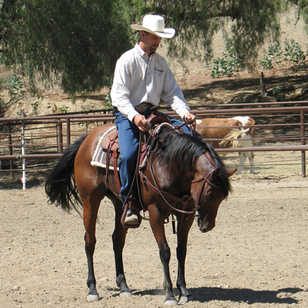
A leverage bit gives me the feeling of having more control than I actually have. But, in fact, the leverage (or shank) bit doesn't give me any more control than any other bit. If I have to pull 5 pounds to stop my horse on that bit, I still have to put 5 pounds on this bit. Except I'm only pulling about a pound's worth because a pound from me feels like ten down there due to the leverage created. It makes me feel like I have more control. It makes me feel like the horse is softer and more responsive, But if I allow him to, the horse will soon begin pulling on the shank bit - just as he would any snaffle bit.
A leverage bit will allow me to teach him to keep his head straight and break at the poll - but that's about all I'm going to be doing. I do use a leverage bit, if I want to work on keeping horse's head in position or to keep him square between the reins. But while the bit might be keeping his head correct, it's my body, my seat that's telling him where to go. For instance, if I were riding toward you and I tell the horse to take his hips to the left and his shoulders to the right or the left, then it's my body that's telling the horse how to move, not the bit. The bit is just keeping him "in frame." The reason then that I don't train in a curb or leverage bit is that I can't work the horse side to side; I can't work him vertically and I have no way to correct him. If I'm using a leveraged bit and the horse doesn't move off my leg, I'm not able to pull his head off to the side and correct him. All he feels when I put pressure on the reins is pressure on both sides of his face and he'd simply keep driving his head down.
Regarding types of snaffle bits: It makes no difference what specific kind of snaffle bit you use. You can use an O-ring or D-ring or full cheek. If it's an O- or D-ring, use a chin strap to keep it from pulling through the horse's mouth if you were to pull and it was to open it's mouth too wide. Some horses will panic when they first feel that sort of pressure. So in that respect, a snaffle bit will actually get a horse to calm down faster because the bit doesn't scare them. You may want to work with a shank bit occasionally so that when (or if) you show your horse it doesn't panic from the pressure. It's a different type of pressure because it applies pressure at different points of the horse's head. It's also more severe because of the leveraged effect. With a snaffle but you can pull like crazy and the horse will just lay on it. But, if you were to get a horse light in a snaffle bit, then put a leverage bit in their mouth, the horse is much more sensitive. It gives you a little extra edge in the show ring - in your stops for instance. Wanna teach your horse to drop its head and stay relaxed? When you're finished with this article, click here to read about the "Classic Serpentine."
|
|

