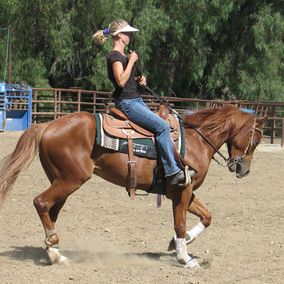
All you have to do is keep changing directions - for twenty minutes. You can start this exercise at a walk and then at a trot when you feel comfortable.
"The more excited or nervous the horse is, the more important it is for you to not let him go straight. If you take a snaffle bit, which is what you should be riding in, and you pull on two reins, what you do is you just make them smile. That's it. They're going to pick their head up and you're going to pull their cheeks back. That's all that will happen.
"You may want to try this first at a standstill, then at a walk and a trot when you're comfortable. (But it's easier when you start with movement.) Walk your horse out and pick up one rein (not two). Add enough pressure so that the front leg stops but the hips keep moving for two steps. (Stop now and picture that in your mind: You'll be doing a quick "turn on the fore." The front inside leg will stop. The back legs will continue moving around the front, like the hands of a clock.) When the horse takes that second step, release the rein and walk out the other way.
"If the horse doesn't stop, you're not adding enough pressure to stop the...
This is something you can use the next time you're hanging out with other riders and the horses begin messing with each other, the way they do, snapping at each other. In that case the moment your horse even looks at another horse, he's handing you the opportunity to practice this "head down cue."
When you pick up the reins, you only want the head to drop. That means that if you pick up the reins and he raises his head waaaaay up in the air, you're still only waiting for it to drop - not back to where it was, but just drop. This means that you may be releasing when his head is high in the air. That's okay. Don't think "The head has to be at x-feet" think "The head just has to drop."
- Print out from home
- 5 Days, 5 chapters
- Learn at your own pace
& lead directly to your country's eBay site for current listings of related products selling near you
Find this article faster next time:
Issue Four, Part 2 of 2
Make Your Horse Stop
Here's a great riding tip: I won't ask my horse to stop. I just quit riding. If he doesn't stop then I go right back to working on something I need to work on. The more excited the horse is, the more important it is for you as a horse trainer to do this. You gotta work hard; you've got to pick up the reins, move the shoulders, soften that nose up, make something happen. You want to make sure that your aggressive, you're assertive. You know what you're doing and where you want to go.
Rein In Your Horse's Speed Online Course
• 5-day course, study at your leisure
• homework/exercises assigned by John Lyons Trainer Keith Hosman
• learn to get control of the flighty or too fast horse
• see more
This is the solution anytime your horse is doing something you don't want him to do: You need to replace the action you don't want with action you do want. Don't discipline, replace. If I don't want my horse to stand here and paw, then I'm going to ask him to practice something we need to practice. If he wants to fight with his head, then I'm going to keep pressure on the reins, waiting (on my release) for him to soften up - all the while practicing a particular step such as consistently stepping the left front foot up and to the right. If he wants to paw, we work more intensely. If he even thinks about laying down, I'm going to ask him to move. If he wants to dance around... you guessed it, I put him to work. I turn the negative into a positive by improving some aspect of that horse's training.
When he decides he wants to stop, then I'm going to stand here and wait. But if he decides to move (or paw or antagonize another nearby horse), I'm not going to stop him. I'm going to ask him to get moving and improve something. I'll become a more assertive trainer; I'll ask more out of my horse. I can't stress that enough: the more nervous, the more excited the horse is, the more important it is for you as a horse trainer to become more active. Put energy into it and make the horse sweat. Make something happen. Don't wait.
Disclaimer: Equine training can be a hazardous activity which may subject the participants to possible serious injury. Keith Hosman, his associates, and other trainers listed on this site will not assume any liability for your activities. Our newsletter, books and videos provide general information, instruction and techniques that may not be suitable for everyone. No warranty is given regarding the suitability of this information, the instructions, and techniques to you or other individuals acting under your instructions.
All Rights Reserved (TM) 2011, horsemanship101.com
No part of this website, including newsletter material and photos, may be reproduced without our express written permission.
Get the performance and relationship with your horse you desire. We'll automatically let you know when a clinic's coming to your area when you sign up for our free training newsletter, (upper-left sidebar, this page).
There are certain products that every long-time Lyons fan carries in his equine tool kit. They're the "gotta haves." Here are a few essentials - as recommended by this John Lyons Certified Trainer, Keith Hosman.