Ask a Horse Trainer


go to home pageKeith Hosman's biosend us an emailJohn Lyons links and morestep by step horse training email
go to: homepage go to: homepage go to: homepage


Sign Up Today!

If your horse is buddy sour or won't speed up, slow down, or pick up its leads, you missed the latest training methods from John & Josh Lyons. Sign up here to get step-by-step lessons emailed every month free.

country

Note: We will not sell you out to spammers.

Sample Our Newsletter
"Keys To Improvement," Issue 8, part 2 of our FREE monthly newsletter

From our How to Train a Horse Series:

How many times do you think you've ridden your horse? A thousand? Five hundred? Just guess. What if every time you got on, you improved something, no matter how small? If you could just see some little improvement for each of those thousand times you've been on that horse, that's a thousand percent improvement. After all, you can't get the horse trained all at once; the key is to make some small improvement every time you get in that saddle. Your mindset, when you get in that saddle, is that something is going to get better. Now, it might not be what you'd planned on working on because it's not a matter of what you want to work on that day – your horse decides for you. You may want to work on your right lead, but the horse says "No, I'm just going to run away." So you may not work on leads at all; you may just work on...

(sign up / read more)


From John Lyons Trainer Keith Hosman


Stop Bucking Study Course
A Downloadable Book

A sample from Day 3:

You’ll want to gradually release, rather than “all at once.” Don’t drop the reins, but rather take one or two seconds to follow his release. The horse thinks he’s getting away with something - but it’s a something we wanted the whole time.

In a matter of moments your horse will be dropping his head almost to the ground. When the horse very clearly understands to drop his head, then it’s time to use less and less pressure. You want to get to the point where you can simply raise the reins with your thumb and forefinger and his head will drop. It becomes comical at this point because your horse will look as though he KNOWS he’s pulling one over on you. You’ll also need to begin insisting (through the timing of your release) that the horse drops his head without pulling on the reins.

- Print out from home
- 5 Days, 5 chapters
- Learn at your own pace

Just $4.99

For more info:
this course | all courses

Available Downloads:
"Stop Bucking"
"Rein/Speed" (for Nervous Horse Owners)
"Round Pen First Steps"
"Trailer Training"


clinic infowhat people say about our clinicsshop online
browse article archiveperuse articles from outside writersfind training by relevant topicsee past issues of the newsletterhorse training courseslisten to training audio clipswatch free horse training video clips
Horse training courses teach trailering, round penning, how to deal with bucking and speed control.
Lyons Training 101

Issue Number:  Nine
Going And Stopping

written by Josh Lyons & Keith Hosman


Print This Article for Free
(This is a large file and it might take a moment to load. Note: The article might be paired with another.)
See Complete List of Horse-Training Articles
Tell A Friend (Click to send them an email)
Link to this Article (Click for code and instructions)
& lead directly to your country's eBay site for current listings of related products selling near you
Find this article faster next time:  


Issue Nine, Part 2 of 3
Hip-Shoulder-Shoulder Part 2:
Begin the Exercise
 
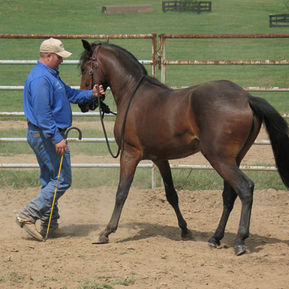
We'll break this exercise down into several steps. Practice this first at a walk, then progress to a trot when you're ready. Here's the first step: Walk forward and pick up one rein. Add whatever pressure (or angle) that it takes to make the shoulder (or foot) on the same side stop moving – but cause the hind legs to take at least two steps sideways (around the front, as if his front feet are nailed down – not like a propeller). Release, walk forward and do the same thing on the other side. Alternate sides often at this stage of the exercise. Later, when you begin backing your horse, keep to the same side till your horse backs willingly.

Here's a specific example of what you'll do: Pick up the left rein, pull the horse's head off to the left side (sort of like you're steer wrestling), searching for the angle and amount of pressure it takes to get the left shoulder to stop. Simultaneously apply the leg pressure (both legs evenly) it takes to keep the horse moving. By blocking his shoulder – but still saying "move" – your horse will have little choice but to move his back legs off a step or two to the right. Think of it this way: If you're squeezing or kicking and saying "move horse" – yet you're blocking him from going forward with your rein, he'll eventually find a release by taking that step to the side with his rear end. So the two keys at this stage are: 1) stop the shoulder; 2) get him to move his rear a step to the side. Always, always, always end the sequence by relaxing your reins and walking forward. And do it immediately, without hesitation. You want the horse thinking "forward" and "What's next?" not "park and snooze."

John Lyons Rope Reins

• Get the reins we use in our clinics
• The reins used and recommended by John Lyons himself
• Sizes available for "regular" and "large" horses.
see more


Buy now: $41.99

What you're doing is "disengaging" the left hind foot and "engaging" the right hind foot. While one "goes to work," the other "gets dragged." (That's an important concept that later plays out when you're trying to stop shoulders from leaking out of a turn or caving into a turn.)

This is a "single rein" exercise. Use the same rein on the same side to bring your horse's head around, to stop his shoulders and to disengage his hindquarters as described. Later, you'll use that same rein to get him to back up. Don't cheat and use two hands to pull. Using two hands will cause your horse to resist the pressure and get heavy (read: drag and pull against you). Using just one hand helps keep the horse's body curved, lighter and just a little off balance. Those are three things we use to our advantage. Your horse can push all day long when his body parts are lined up in a row against your push. Think of his skeletal system as a pile of building blocks stacked one behind the next. It takes no strength to offer great resistance. But, when you put a little curve in his body (that is, move his head or tail a couple of inches off center) suddenly he's got to use his muscles to resist. He'll soon find it's much easier to relax and "go with the flow" than to resist.

Tip: Here are two things to try to get the shoulder to stop and keep the back feet moving: First try swinging your hand way out to the side and then, in one smooth wide arc, bring that same hand (as a fist) as close to your opposite shoulder as you can. You'll be outlining the shape of the famous "Nike Swoosh" checkmark logo with your hand. The most common mistake seen at this point is making your hand move at angles and/or with choppy movements. Remember to make your "swoosh" movement wide, smooth and in one graceful arc. (And the odds are pretty good that you need to grab the rein closer to his mouth than you are.) As an alternative, you can also try lowering your hand more to your side and do your best to pull your horse's nose to his rear end. Don't be afraid to try using two hands to pull on the same side when you first begin in order to get your point across. (But remember to keep your balance and sit up straight on your horse.)

Tip: A common question is "How do I know when the front of the horse is stopped?" When you first begin, try picking up a rein and stare at the shoulder on the same side. See it moving forward and backward with each stride? Apply the pressure and angle that it takes with your rein to make it stop moving. It may stop only briefly, maybe half a second. Don't over-think this, just make it happen. When his shoulder is stopped and you feel his back legs take a step LET GO. If the front is stopped – but he's still moving his back feet – then he has to be disengaging. There's nothing else he could be doing.

Another tip: You might forget which way his back legs should move when you pick up a right or left rein, but here's an easy way to remember: If you were simply riding down the trail and picked up the left rein and pulled till your horse turned to the left, which way would his butt go? To the right, right? Keep it that simple and the exercise is easy.

Yet another tip: Don't lock your hand into one place. You'll need to constantly adjust the position of your hand in order to compensate for the movements of the horse.

The most common problem we see: Keeping your horse moving may prove to be your biggest challenge. Sluggish horses that look for any excuse to slow down will stop dead in their tracks when you first pick up a rein and ask for such a sharp maneuver. Be ready for it and really motivate them with your legs (, , threats, bolt of lightning, whatever it takes) to keep moving. If your horse begins to freeze up more and more, then simply drop back a step and ask for less of a "sharp turn" (and really kick or squeeze). Then you'll progressively whittle it down, asking your horse to turn more and more "abruptly." More likely than not, you'll need to take your hand/arm waaaaay out to one side or the other because any sort of backward pressure on the reins will cause your horse to stop. If that's the case, take yet another step back in your training: Try simply walking a straight line, picking up a rein and asking your horse to bend it's neck and "gently arc" to the right or left, then release on the turn as he softens, however briefly. Your goal at that point has to be to keep the feet moving, all the while building softness and dissolving resistance. Concentrate on keeping the feet moving, gradually making your turns sharper and sharper. This is called "You gotta start somewhere." Do whatever it takes to keep the horse moving and softening. If you stick with it, he'll soon start relaxing and you'll be able to move ahead. When your horse is relaxed this exercise is actually quite easy.

How we've progressed: You've been moving the hips to get the shoulder – and the front foot – to stop. We can't stop all four feet (yet) but we do have a way to stop one. We've started teaching the horse that "stop" means more than ceasing movement. It means something specific like "stop moving your shoulder to the left and begin moving it to the right."

End of Issue Nine, Part 2


***


Read previous article: Solve Every Horse Problem

Read next article: Back Easily With Hip Shoulder Shoulder

See Complete List of How-To Articles

***


Related Letters
 

See related Questions & Answers (letters from readers like you)


back to top


***

Disclaimer: Equine training can be a hazardous activity which may subject the participants to possible serious injury. Keith Hosman, his associates, and other trainers listed on this site will not assume any liability for your activities. Our newsletter, books and videos provide general information, instruction and techniques that may not be suitable for everyone. No warranty is given regarding the suitability of this information, the instructions, and techniques to you or other individuals acting under your instructions.

All Rights Reserved (TM) 2009, horsemanship101.com
No part of this website, including newsletter material and photos, may be reproduced without our express written permission.


Get the performance and relationship with your horse you desire. We'll automatically let you know when a clinic's coming to your area when you sign up for our free training newsletter, (upper-left sidebar, this page).

team roping dummy | horse steer wrestling | reining patterns | barrel racing tips | high point performance horse | craig cameron horsemanship | pat parelli videos | pat parelli horse training | parelli horse trainer | pat parelli video | famous horse riders | famous horse trainer | famous horse trainers | horsemanship true | horse breaking training


PRIVACY POLICY

Lyons Training 101: Issue Nine, Part 2
"Ask a Horse Trainer: Stop Your Horse With Hip Shoulder Shoulder"
bookmark Horsemanship101.com for more info


AUDIO CLIP
Listen to Josh Lyons

Click Josh's picture to play
"Hip Shoulder Shoulder Disengagement"

Hip Shoulder Shoulder Disengagement

Note: Audio clips are large files and may take several moments to load.

Read Josh's bio


Josh Lyons

One of the most sought-after clinicians in his own right, John Lyons' son Josh has produced a winning DVD series for the performance horse owner.


Josh Lyons Foal Handling
Buy today: $38.99


Josh Lyons Teaching Tricks
Buy today: $38.99


Josh Lyons Spins and Shoulder Control
Buy today: $38.99


Josh Lyons Leads and Lead Changes
Buy today: $38.99


Josh Lyons Sliding Stops and Rollbacks
Buy today: $38.99


Josh Lyons Teaching Series
Buy today: $158.99


Essential John Lyons

There are certain products that every long-time Lyons fan carries in his equine tool kit. They're the "gotta haves." Here are a few essentials - as recommended by this John Lyons Certified Trainer, Keith Hosman.


Bringing Up Baby
Buy today: $23.99

Help Me Help My Horse
Buy today: $25.99

John Lyons Reins
Buy today: $41.99


John Lyons Audio

Don't waste another moment sitting in traffic! Listen to John Lyons discuss simple solutions to common horse problems.


Conversations with John Lyons
$98.00


Fear in the Rider, Fear in the Horse CD
$28.99


Getting Your Horse's Attention CD
$28.99


Horse That Bites, Abused Horse CD
$28.99


Sensitive Ears, Mouth, & Feet CD
$28.99


The Calm Down Cue CD
$28.99


Recommended

Who knows his products better than one of his certified trainers? I thoroughly recommend the following - they should be at the top of every list.


Bringing Up Baby
$23.99


John Lyons Reins
$41.99


Riding Manual (includes 4 DVDs)
$197.99


New

Wondering what to buy for the Lyons fan "who has everything"? (Maybe they don't have his latest.)


From Ground to Saddle
$153.99


Troubleshooting
$28.99


Best Sellers

It just seems that everybody's gotta have certain products. Here's a list of perennial favorites.


Controlling Your Horse's Speed
$38.99


John Lyons Reins
$41.99


Troubleshooting
$28.99