
Speed Up Your Slow Horse
July 10, 2014
Written by: Josh Lyons & Keith Hosman
Written by: Josh Lyons & Keith Hosman
|
Here's what to do when your horse "won't go."
One of the hardest things, is that as you ride your horse, the more you mess with the bit, the more you restrict movement. You're restricting movement every time you pick up the rein. If I have a horse that doesn't want to move and I pick up that bit, restricting his movement, then it's going to take more drive from me to keep this horse wanting to move. It actually makes it harder for me to keep the horse moving through it, but he's actually learning it better. This article is from the How To Break A Horse series and explains how to speed up a slow horse. 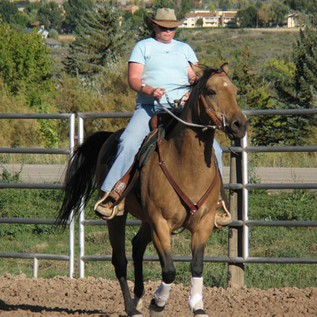
You can fix the lazy horse as you ride through any exercise. The first thing that makes a horse responsive or lighter is having a clear cue from you, the rider. A cue is something that you ask the horse and can get the horse to do. That means a cue to stop will be picking up the reins. That would be a cue to stop. A pre-cue is something you do before the cue. A pre-cue is "ho." If I ride forward and I say "ho," and he doesn't stop, I'm going to say "ho" and pick up the reins to say "That meant stop." So pretty soon, when I ride forward and I say "ho" the horse stops. So a pre-cue is something you do before a cue that makes a horse lighter and more responsive. It's the same thing with your legs. What do you do before you use your legs? You sit forward, pick up the reins, kiss to them. But what's the first that you do before you squeeze or kick your horse? You take your legs out. You take your legs out, then you bring them together. So practice that. Practice taking your legs off and if he doesn't move, then tell the horse "Hey, that meant move" with a kick. And when you bring them together, be prepared to kick until something happens. So practice that and pretty soon, when you take your legs away from the horse's side, that'll mean "move forward." So I'm not using my legs to keep kicking my horse. Practice this and remember, when you bring them together, bring them together hard enough to get a change of leg speed. If you kick him and you just kick him to keep him going, then it's only going to get worse.
When you kick, something has to change. They don't have to run all out for an hour, but just for a split second. When I ride, my legs mean "give me a change of leg speed." They don't mean "just go forward" and they don't say which direction. They just say give me a change of leg speed. The bridle tells them the direction. My seat tells them the direction. Say you're backing up, and the horse isn't backing up fast enough, then use your legs to say "Give me a change of leg speed." My legs mean, not to walk, not a trot, not to lope, they mean give me a change of leg speed. Every time you use your legs, make sure your horse gives you a change of leg speed. Not just a continued walk or a continued trot, but a change of leg speed. If you can take your seat and tell your horse to go faster by sitting up, then why can't we do the same thing and use our seat to tell the horse to go slower? Our seat does. If we sit down and ride slower, and he doesn't ride slower, then I can pick up the reins and say "Hey you missed it. Back there was a cue." Remember, your horse is learning the whole time you're riding.
To help your horse understand, it's important that you offer a strong pre-cue. Sit forward, kiss to her, pick up the reins, do something. Offer a strong pre-cue so your horse understands better. The second part of this is to give your horse a chance. Hesitate before you kick. And if he moves, don't kick. If he doesn't move, then bring your legs together hard. Say "Hey, that meant move." It's better to do that than to keep bumping him all the time with your legs, to keep kicking up. If you go to use your legs, bluff first. Act like you're going to use them the don't use them. That's how you get your horse responsive off your legs, you bluff. The more you use them, the more he's learning to lay on your legs. The more you use them, the more he's learning to become non-responsive. So you want to use your legs less. But when you do use them, use them hard enough that you make something change. Otherwise I'm just going to keep kicking him to go and pretty soon he's going to learn start thinking "I get kicked if I go, I get kicked if I stop... I might as well stop." Tip: Teach almost anything to your horse with the "Clock Work Exercise." That's a chapter in the basic training book "What I'd Teach Your Horse" - and you can hear the whole section right now for FREE on audio when you click here.
Wanna teach your horse to drop its head and stay relaxed? When you're finished with this article, click here to read about the "Classic Serpentine."
|
|

