I could walk by my horse all day and he doesn't have to even recognize that I'm here - and it would be a waste of my time to ask him to do anything. But if I took a stick and started poking him, then all of a sudden it becomes a whole lot more important to the horse that "I'm here." When you ask a horse to do something, a lot of other things are going to draw his attention and it's important that you become more important, no matter what it takes. The horse has to fully recognize that you're there. That's important, otherwise, you can't get to the next step: You can't get him to respond in a certain way.
"You've all heard that you want to get your horse's attention first. That's nonsense. We don't care about the horse's attention; we really don't. I don't expect the horse to think about me before he does something. Have you ever been on a trail ride with your horse when the horse did everything you wanted him to do? What were you doing? You were looking around, talking to people, enjoying the ride. Did you care for even one moment what your horse was thinking? No, you didn't, because he was doing exactly what you were asking him to do. You didn't care what he was thinking because...
Is this you? You think your horse is about to slow down so you give him a good kick? That makes sense to you - but the horse figures he got kicked for no good reason. You'll burn out your "move faster" cue quick that way. I need you to start thinking and riding differently.
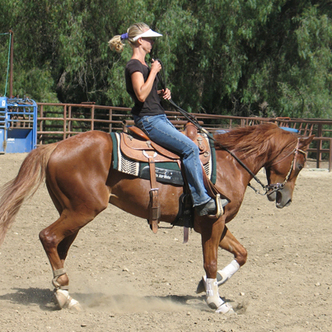
Instead, continue this exercise by walking your horse forward and asking it to speed up; demand a "noticeable change of leg speed." If your horse was traveling at 4 mph, ask for faster and make sure he does just that. It's not a maybe it's a definitely. If he doesn't speed up, kick until he does. If he breaks into the next higher gait, ease him back down and keep trying.
If your horse begins to slow down on his own when you travel 30 feet at the increased speed, then ask him to slow down the next time at 28 feet. It's key that you ask for the slow down - it's not supposed to be his idea. Remember, you don't want to be in the habit of kicking him when you "think" he's going to slow down so you've got to make the first move. Ask him to slow a moment before you think he was going to slow down anyway. You'll concentrate on building the range your horse first gave you; if it was 7 and 10, see if you can't build that out in small increments to 5 and 14, 2 and 16, etc.
- Print out from home
- 5 Days, 5 chapters
- Learn at your own pace
& lead directly to your country's eBay site for current listings of related products selling near you
Find this article faster next time:
Issue Five, Part 2 of 4
Slowing Your Horse
To help slow my horse, I hum. I hum because it naturally changes my seat. So when I'm practicing loping, and my horse is going faster than I want, then I sit down and I count or hum. So, I'll pick up speed and I'll say go faster, then I'll sit down and hum. If I change my seat and the horse does not slow down, then I'm going to stop them. I'm going to say "No, you missed your cue to slow down back there." I'll go forward and do it again. I'll speed him up, then I'll sit down and hum. I can slow him down with the same "seat" I used to speed him up. Sometimes when were having trouble getting our horse to go, we're not riding forward enough with our seat. It's natural for the trainer's seat to actually cause the horse to slow down by sitting down too much or relaxing a little too much.
Rein In Your Horse's Speed Online Course
• 5-day course, study at your leisure
• homework/exercises assigned by John Lyons Trainer Keith Hosman
• learn to get control of the flighty or too fast horse
• see more
Disclaimer: Equine training can be a hazardous activity which may subject the participants to possible serious injury. Keith Hosman, his associates, and other trainers listed on this site will not assume any liability for your activities. Our newsletter, books and videos provide general information, instruction and techniques that may not be suitable for everyone. No warranty is given regarding the suitability of this information, the instructions, and techniques to you or other individuals acting under your instructions.
All Rights Reserved (TM) 2011, horsemanship101.com
No part of this website, including newsletter material and photos, may be reproduced without our express written permission.
Get the performance and relationship with your horse you desire. We'll automatically let you know when a clinic's coming to your area when you sign up for our free training newsletter, (upper-left sidebar, this page).
There are certain products that every long-time Lyons fan carries in his equine tool kit. They're the "gotta haves." Here are a few essentials - as recommended by this John Lyons Certified Trainer, Keith Hosman.